1. The B2B Hard Seltzers Ecosystem: Commercial Formulations & Product Recommendations
The global market for Hard Seltzers has expanded far beyond basic fruit-flavored malt beverages. Modern procurement teams and beverage creators must navigate a complex landscape of base spirits, carbonation dynamics, natural flavor extract systems, and sweetness balancing. When formulating a commercial Hard Seltzer, selecting the correct alcohol substrate dictates your regulatory path, federal tax liability, shelf-life stability, and market placement.

Key Commercial Product Sub-Categories
To meet evolving consumer search intent and retail purchasing behaviors, BevSource categorizes Hard Seltzers into four core commercial formulations:
- Fermented Cane Sugar Base Seltzers: Produced by fermenting a high-gravity sugar wash (dextrose or sucrose) using specialized neutral yeast strains, followed by activated carbon block filtration. Highly cost-effective for high-volume retail distribution.
- Real Distilled Spirit-Based RTD Seltzers: Formulated using Neutral Grain Spirit (NGS), Premium Craft Vodka, Tequila Blanco, or Aged Rum. Provides a premium taste profile and clear consumer messaging.
- Functional & Botanical Seltzers: Enhanced with adaptogens, nootropics, natural electrolytes, or organic botanical extracts (e.g., ashwagandha, green tea extracts, hibiscus, elderberry).
- Low-ABV & Session Seltzers (2.0% – 4.5% ABV): Formulated with ultra-clean water matrices, subtle natural fruit essences, and minimal glycemic impact to satisfy clean-label and health-conscious consumer demand.
Commercial Substrate Comparison Matrix
Choosing the wrong base can result in unexpected excise tax rates, mandatory pasteurization hurdles, or reduced shelf stability. The table below outlines technical parameters for beverage procurement managers:
| Alcohol Substrate Base |
Typical ABV Range |
US Federal Tax Classification |
Filtration & Processing |
Primary Packaging & Co-Packing Needs |
| Fermented Sugar (Cane/Dextrose) |
4.0% – 6.0% |
Beer / Malt Beverage Rate |
Carbon-Block De-colorization & De-flavoring |
Tunnel Pasteurization / Sleek 12oz Cans |
| Neutral Grain Spirit (NGS / Vodka) |
4.5% – 8.0% |
Distilled Spirits Tax Rate (Higher) |
Precision Inline Dosing & Blending |
DSP Permitted Co-Packing Facility |
| Malt Barley Base (Cleared) |
4.0% – 5.5% |
Malt Beverage Tax Rate |
Ultra-filtration & Reverse Osmosis |
High-Speed Can Filling / Carbonation 2.8+ Vol |
| 100% Agave Tequila Base |
5.0% – 7.0% |
Distilled Spirits Tax Rate |
Citric Acid & Real Fruit Dosing |
Sterile Filling / Micro-filtration |
2. Why Industry Leaders Partner with BevSource for Hard Seltzers Scaling
Developing a shelf-stable, commercially viable Hard Seltzer requires deep operational knowledge across ingredient science, packaging engineering, and manufacturing management. With over 20 years of experience, BevSource serves as America's premier beverage outsourcing partner. We bridge the gap between initial concept and commercial shelf placement.
🧪 Turnkey Formulation & Benchtop Lab
Our proprietary pilot lab facility ("The Lab") allows brands to refine Brix, acid ratios, carbonation volumes, and flavor stability at benchtop scale before committing to full production runs. This drastically lowers initial R&D costs and technical failure rates.
🏭 Vetted National Co-Packer Network
Finding a contract packaging plant equipped with high-speed can lines, tunnel pasteurizers, liquid nitrogen dosing, and TTB Distilled Spirits Plant (DSP) licensing is complex. BevSource manages vendor selection, audit, contract negotiation, and production oversight.
📦 Bulk Packaging & Ingredient Sourcing
Leverage our aggregate buying power to secure competitive pricing on 12oz sleek aluminum cans, 202 diameter ends, custom shrink sleeves, natural flavor extracts, organic sweeteners, and specialized yeast nutrients.
⚖️ TTB & FDA Regulatory Mastery
We handle formula submissions, TTB COLA label approvals, state liquor board compliance, nutritional panel generation, and mandatory allergen labeling to safeguard your brand against costly compliance halts.
Ready to access our complete Hard Seltzer supplier directory and formulation whitepapers?
Get Catalog
3. Proven Track Record: Brands Engineered & Scaled via BevSource
BevSource has helped hundreds of beverage enterprises—from disruptive venture-backed startups to iconic global beverage powerhouses—navigate complex beverage launches. Below are examples of iconic brands leveraging our production, sourcing, and contract manufacturing ecosystem:

Blue Norther Hard Seltzer
Real fruit juice formulation, natural sugar base development, sleek can sourcing.
Bravazzi Hard Italian Soda
Craft malt-base formulation, natural citrus flavor integration, regional co-packing.

JuneShine
Organic hard tea & kombucha scaling, supply chain ingredient optimization.
Jack Daniel's RTD
Enterprise scale-up support, quality assurance, post-production logistics.
4. Future Sourcing & Procurement Trends for Hard Seltzers (2025–2030)
As global search engine intelligence shifts toward intent-driven AI discovery, beverage procurement specialists must prepare for four major structural macro-shifts in the Hard Seltzers landscape over the coming five years:
Trend 1: The Transition from Sugar Base to Real Spirit Substrates
Consumer scrutiny over "malt flavor aftertaste" has driven rapid growth in spirit-based RTD (Ready-To-Drink) seltzers containing real craft vodka, blanco tequila, or white rum. Sourcing teams must secure stable access to 190-proof Neutral Grain Spirits (NGS) and establish relationships with licensed Distilled Spirits Plants (DSP) capable of precise liquid blending.
Trend 2: Clean-Label Flavor Extracts & Real Fruit Cloudiness Management
Artificial flavor drops are being replaced by cold-pressed fruit extracts, essence water phases, and single-origin botanical distillates. However, introducing real fruit purees or unrefined juices introduces pectin solids, cloudiness, and yeast nutrition. Procurement directors must source enzyme clarifying agents or invest in tunnel pasteurization to maintain visual consistency and extended shelf life (12+ months).
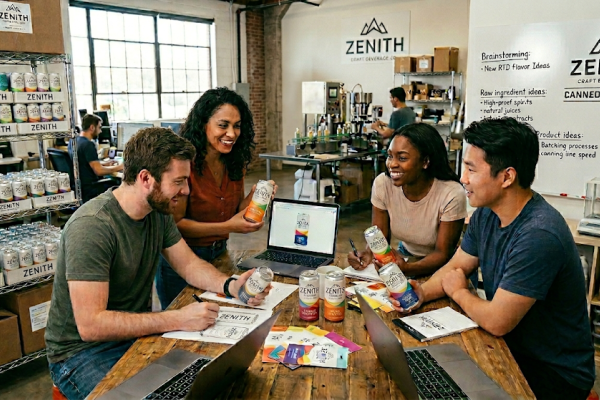
BevSource R&D specialists analyzing real-fruit cloudiness stability and Brix levels for commercial Hard Seltzers.
Trend 3: Aluminum Can Supply Chain Resilience & Lightweighting
Aluminum can volatility remains a primary bottleneck in beverage manufacturing. The industry is rapidly adopting 202-diameter sleek 12oz cans with lightweight ends (CDL/ISE) to minimize raw aluminum consumption. Sourcing strategies now focus on securing multi-year contracts with major can fabricators, alongside flexible short-run shrink sleeve digital printing options for limited-edition seasonal seltzer drops.
Trend 4: High-Gravity Brewing & Inline Dilution/Carbonation
To optimize co-packer throughput, major brands are turning to high-gravity fermentation (fermenting sugar bases up to 12-15% ABV) followed by precision inline automated dilution with deaerated water, real-time dosing of natural flavors, and inline carbonation (2.8 to 3.2 volumes CO2). This technique increases tank turnover rates by up to 300%.
5. Global Market Development Trends: Consumer Search Intent & Retail Category Positioning
AI-driven market insights confirm that modern consumer queries around Hard Seltzers center heavily on wellness attributes, transparent ingredient sourcing, and premium flavor profiles. Brands positioning themselves for retail success must align their commercial development with these three core market drivers:
Zero-Sugar & Keto-Friendly Assertions
Over 68% of online search queries regarding Hard Seltzers involve terms such as "zero carb," "sugar-free," "keto alcohol," and "gluten-free." Commercial formulations must utilize non-caloric natural sweetening systems (like high-purity Stevia Reb-M or Monk Fruit) or rely exclusively on clean spirit bases with zero residual carbohydrates.
Functional & Adaptogenic Additions
The convergence of functional wellness drinks and beverage alcohol has created a demand for seltzers containing functional ingredients. Adding L-Theanine, electrolytes (Magnesium, Potassium), or natural organic fruit teas provides clear product differentiation in crowded retail aisles.
Variety Pack & Multi-Pack Efficiency
Retail buyers from major supermarket chains heavily favor brands offering 8-pack, 12-pack, or 24-pack rainbow variety mixes. Co-packers must feature automated secondary packaging lines capable of high-speed multi-flavor variety cartoning.
6. Global Procurement FAQ: Critical Questions Answered for Beverage Directors
Below are technical answers to the top questions asked by global beverage buyers, procurement executives, and brand founders when launching or scaling a commercial Hard Seltzer line:
Q1: What are the main differences between Fermented Sugar Base and Neutral Spirit Base for Hard Seltzers?
Fermented Sugar Base: Formulated by fermenting cane sugar or liquid dextrose. Legally classified as a malt beverage or beer alternative in many US jurisdictions, allowing distribution through beer wholesale networks and retail sales in grocery/convenience stores. Lower tax rates, but requires filtration to strip off-flavors.
Neutral Spirit Base: Made by blending Neutral Grain Spirits (NGS) or distilled vodka/tequila with carbonated water and natural flavors. Offers a crisp, clean taste profile with zero yeast off-flavors, but incurs higher federal distilled spirit excise taxes and requires co-packing in TTB-permitted Distilled Spirits Plants (DSP).
Q2: What is the recommended carbonation volume for canned Hard Seltzers?
Commercial Hard Seltzers are typically carbonated to between 2.7 and 3.2 volumes of CO2. Achieving this level of carbonation requires robust deaeration of the water base prior to gas injection and strict temperature control during filling (usually chilled to 32°F - 36°F / 0°C - 2°C) to prevent excessive foaming on high-speed canning lines.
Q3: How do we achieve 12+ months of shelf life for fruit-flavored Hard Seltzers?
Shelf-life extension relies on three critical controls:
- Microbiological Stability: Utilizing Tunnel Pasteurization (typically 15-25 Pasteurization Units) or sterile membrane filtration paired with preservatives like Potassium Sorbate.
- Dissolved Oxygen (DO) Control: Keeping total DO levels below 50 ppb during blending and filling to prevent oxidation of delicate fruit extracts.
- Can Liner Integrity: Sourcing modern BPA-NI (BPA Non-Intent) polymer-lined aluminum cans engineered specifically for acidic, alcoholic beverage matrices to prevent liner breakdown and pinholing.
Q4: What is the typical MOQ for Hard Seltzer contract packaging?
Minimum Order Quantities (MOQs) vary by co-packer scale. Specialized pilot facilities require as little as 2,500 to 5,000 cases (approx. 60,000 to 120,000 cans) per run. Enterprise-scale commercial plants generally mandate 15,000 to 25,000 cases per SKU. BevSource helps brands optimize production schedules by matching them with co-packers suited to their volume stage.
Q5: What TTB approvals are mandatory prior to selling Hard Seltzers in the USA?
All commercial Hard Seltzers distributed in the United States require TTB Formula Approval (evaluating ingredient safety, artificial colorings, and flavor compound percentages) followed by COLA (Certificate of Label Approval) verification. Spirit-based seltzers must also comply with strict state-by-state control board registration and tax reporting.
Q6: Can BevSource supply custom ingredient premixes for consistent batching?
Yes. BevSource formulates and delivers standardized Custom Ingredient Premixes (combining natural flavors, acids, sweetening systems, and functional ingredients into single pre-measured units). This eliminates batching errors at the co-packer, protects proprietary trade formulas, and streamlines plant production.
7. Step-by-Step Commercialization Workflow with BevSource
Bringing a commercial Hard Seltzer to market demands structured execution across six core phases:
Phase 1: Commercial Formulation
Benchtop sample development, alcohol base optimization, Brix & acid adjustment in "The Lab".
Phase 2: Financial & Supply Chain Modeling
Cost of Goods Sold (COGS) calculation, raw material lead-time forecasting, packaging sourcing.
Phase 3: TTB & Regulatory Filings
Formula submission, TTB COLA filings, state licensing registration, and label compliance checks.
Phase 4: Co-Packer Selection & Audit
Matching brand volume with vetted co-packing facilities equipped with canning lines & pasteurization.
Phase 5: Pilot Run & Scaling
Initial commercial production trial, QA testing, micro-testing validation, and yield evaluation.
Phase 6: Post-Production Logistics
Freight management, warehousing, distributor delivery coordination, and ongoing supply chain oversight.